Blog

Your blog category

Content Marketing VS Digital Advertising
Blog

Content Marketing VS Digital Advertising: Which One Is Suitable For Your Business?

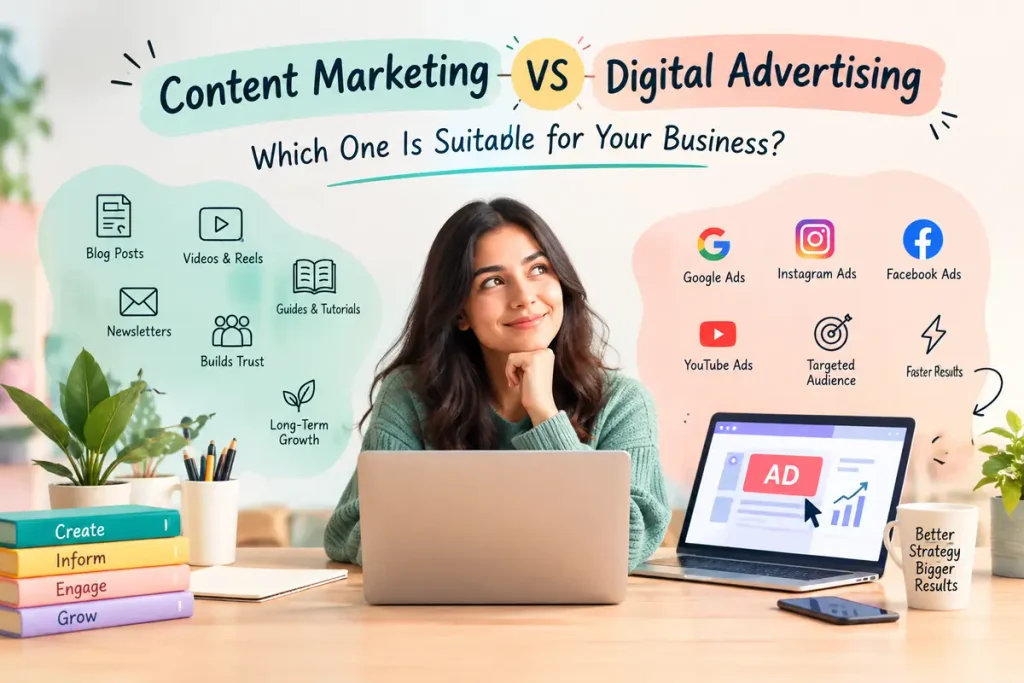
Imagine you have a great product, a good-looking website, and an Instagram page that you update regularly. But there is still one problem people are not finding your business. This is something everybody struggle with today. Having a product or service is not enough. You also need a way to reach the right people and give them a reason to pay attention. That is where digital marketing comes in. Two strategies that businesses often consider are content marketing and digital advertising. Both can help a business reach potential customers, but they work in very different ways.So, when it comes to Content Marketing vs Digital Advertising, which one should you choose?It really comes down to your goals, how quickly you want results, and how much time and budget you have. Let’s make it easier to understand. What Is Content Marketing? Content marketing is all about creating useful content that people actually want to consume. Instead of constantly telling people to buy something, you give them information, ideas, answers, or entertainment that they find valuable. This content can take many forms, including: For example, imagine a skincare brand. Instead of posting only product advertisements, the brand could create content about choosing skincare products, understanding ingredients, building a simple routine, or avoiding common skincare mistakes. Someone searching for this information may discover the brand through its content. Even if that person does not make a purchase immediately, they have now become familiar with the business. That is the real strength of content marketing. It focuses on building a relationship before asking for a sale. What Is Digital Advertising? Digital advertising is a little more direct. Here, businesses pay online platforms to show their advertisements to specific audiences. You have probably seen digital ads while scrolling through Instagram, watching YouTube, searching on Google, or browsing websites. Some common examples include: For example, suppose a local clothing store has a new collection. Instead of waiting for people to discover the collection naturally, the store can run an Instagram advertisement showing the new products to people who are likely to be interested. The biggest advantage is speed. You can create a campaign, set a budget, select an audience, and start reaching potential customers much faster than you usually can with organic content. Content Marketing vs Digital Advertising – Difference At first glance, both strategies may seem similar because they have the same broad goal: getting people interested in a business. But the way they achieve that goal is different. Content-based marketing Digital Advertising Focuses on providing value Focuses on paid promotion Builds relationships over time Can reach people quickly Mainly uses organic distribution Uses paid distribution Can continue bringing traffic after publishing Usually depends on an active campaign Strong for education and trust Strong for immediate reach and conversions Usually produces gradual results Can produce faster results Here’s a simple way to tell them apart: Content marketing earns attention. Digital advertising pays to get attention. Of course, that does not mean one is automatically better than the other. Why Content Marketing Takes Time but Can Pay Off Why Digital Advertising Works Faster Content marketing is more like planting a seed. It need time to grow. Digital advertising is more like turning on a spotlight. Once your campaign is active, your advertisement can start appearing in front of your chosen audience. This makes digital advertising especially useful when a business has a time-sensitive goal. For example, you might want to: Let’s say a restaurant is introducing a weekend special. Waiting several months for organic traffic would not make much sense. A targeted social media campaign could get the offer in front of local customers much faster. That is where paid advertising becomes extremely useful. Which One Costs More? This is where things get a little tricky. It is tempting to say that content marketing is free because you do not have to pay for every person who sees your blog post or social media content. But creating quality content still takes resources. Someone has to research the topic, write the content, design graphics, shoot videos, edit them, optimize them, and publish them. Digital advertising has a more obvious cost because you are paying the advertising platform for distribution. However, you have much more control over your spending. You can decide how much you want to spend per day or for an entire campaign. So instead of asking: “Which one is cheaper?” A better question is: “Which one gives my business the best return for my current goal?” The answer can be different for every business. When Should You Use Content Marketing? Content marketing is a good choice when your main goal is to build something that lasts. It can be especially useful if you want to :- Build Brand Awareness Improve SEO Build Trust Educate Customers Build A Long-Term Audience When Should You Use Digital Advertising? Digital advertising is particularly useful when you need to reach people quickly. It can work well when you want to :- Generate Leads Increase Sales Promote An Offer Reach A Specific Audience Retarget Potential Customers Content Marketing vs Digital Advertising: Which Is Better for SEO? Can You Use Both Strategies Together? Absolutely—and this is where things get interesting.You do not necessarily have to choose between the two.In fact, combining them can create a stronger marketing strategy .Imagine you have written a detailed blog post that answers a common question your customers ask. You could: Now your content is doing more than just sitting on your website. You are using advertising to amplify content that already provides value. This approach can help businesses get both short-term visibility and long-term organic growth. How to Choose the Right Strategy Still wondering where you should start? Ask yourself these five questions. 1. What Is My Goal? 2. How Quickly Do I Need Results? 3. What Is My Budget? 4. Where Does My Audience Spend Time? 5. How Will I Measure Success? Do not rely only on likes or views. For content marketing, you can
Blog

AI Search Optimization Strategies: Powerful Guide

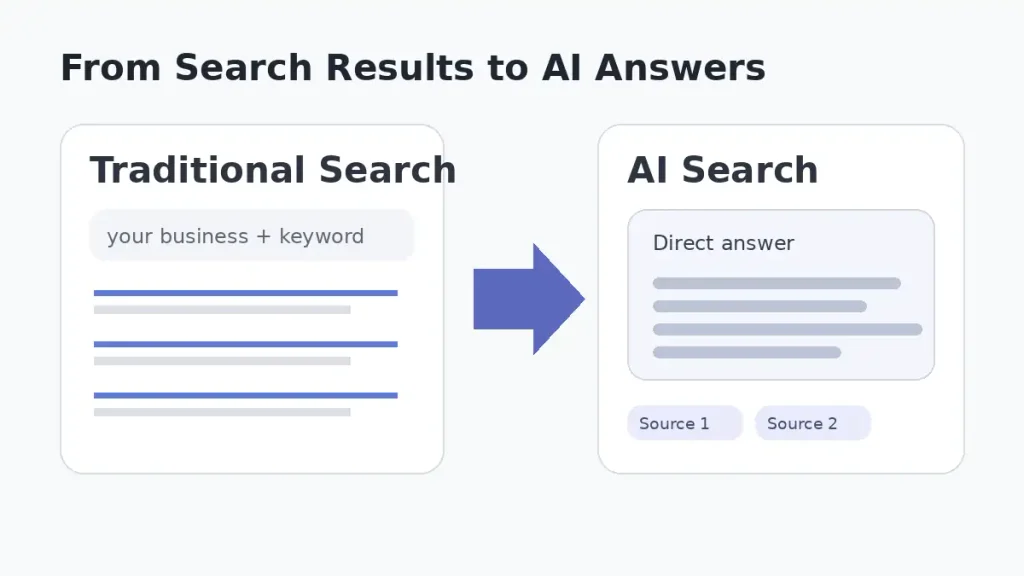
Customers don’t just type a few words and look through ten blue links anymore. They ask complete questions and receive summarized answers from tools such as Google AI Overviews, Chat GPT, Perplexity, and Copilot. This shift has made AI Search Optimization Strategies increasingly important for businesses that want to stay visible. If your brand isn’t part of what people are looking for, you’re not seen when they decide what to buy. This guide explains useful strategies for optimizing your business in the world of AI search, helping your company get found, cited, and trusted in this new environment. What is AI Search Optimization? AI Search Optimization Strategies for Modern Business involve shaping your content, website, and brand presence in a way that helps AI-powered search systems understand, find, and reference your work. Traditional SEO is about getting a webpage to show up in the list of search results. AI search optimization focuses on becoming a source that a language model selects to quote or summarize when it creates an answer. The two disciplines overlap heavily. Quality content, technical health, and authority are still important. The difference lies in how the content is presented and how the system assesses it. AI systems prefer clear answers, organized pages, proven knowledge, and steady signals found throughout the web. AI Search Optimization Strategies help businesses adapt their content for AI-powered search and improve their chances of being discovered. Why Modern Businesses Can’t Ignore It? Three changes make AI Search Optimization Strategies for Modern Business important for businesses today, not just something to try out. Zero-Click Behavior Is Growing When an AI-made summary answers a question on the results page, fewer people click through to see more information. Being cited within that summary becomes the new form of visibility. Trust Is Being Outsourced To Algorithms When an AI assistant suggests a brand, users usually see it as just an objective recommendation. Companies that show up in those suggestions gain trust they didn’t have to pay for. Businesses that start adapting early gain a big advantage that keeps growing over time, because it takes time to build up authority signals Eight Proven Effective AI Search Optimization Strategies For Modern Business 1. Build Strong Expertise On Specific Topics AI systems favor sources that provide in-depth coverage of a subject. Instead of posting random content, group similar topics together to organize the information. Make one main page about a key topic, and then write several detailed pages about related questions. Connect all the pages in a clear and logical way. For example, a logistics company might focus on a group centered around “managing freight costs,” with related topics like fuel surcharges, negotiating with carriers, and planning efficient routes This proves to search engines and language models that your website is a trustworthy source on the entire topic, not just for one specific keyword. 2.Answer Questions Straight Away And As Soon As Possible 3. Make Your Content More Credible And Distinctive  When a machine is choosing whom to cite, having real experience, expert knowledge, authority, and being trustworthy becomes even more important. Strengthen these signals by: Your original insight is your strongest differentiator.AI tools can already provide general advice, so there’s not much reason to reference a page that just repeats the same information. 4.Help AI Systems Interpret Your Content More Clearly 5.Create Content Around Real Customer Questions 6.Fix Your Technical Foundations AI crawlers can only cite what they can access and parse. Make sure your site provides: Check your robots.txt file to ensure you’re not blocking search engines, including those used by AI platforms, from accessing your site. Whether to allow them is a business decision, but it’s done on purpose. 7.Help AI Systems Recognize Your Brand And Expertise The main goal is to build brand mentions and recognize entities.AI models learn about brands by looking at the entire web, not just your website. Repeated mentions in trusted publications, industry directories, review sites, podcasts, and social media channels help models identify your company as a unique entity with a clear area of expertise. For businesses looking for local digital marketing support, working with a digital marketing consultant in Thrissur can help build a stronger online presence. Practical steps include: Think of it as managing your online reputation and image.The more trusted sources link your brand to a topic, the more likely AI systems will connect your brand with that topic. 8.Expand Your Content With Rich And Original Media How To Measure Your Results Just tracking your rankings isn’t enough to measure the results of AI Search Optimization Strategies for Modern Business. Create a measurement process that includes: Manual Prompt Testing Frequently ask AI assistants the questions your customers commonly ask, and note if your brand is mentioned or referenced in the responses. Referral Traffic Look at the analytics to see visits coming from AI platforms and keep an eye on how that changes over time.When more people see your brand through AI, it usually leads to more searches for your brand name. Share Of Voice Compare how frequently your brand appears compared to your main competitors across a set of specific prompts. Conversion Quality People who come to the site after getting a recommendation from AI usually have a stronger interest, so it’s important to track leads and sales, not just the number of visits. Keep a simple spreadsheet, track the main goal, and note any changes after each content update. AI results might not always be the same, so it’s better to check for patterns instead of relying on just one piece of information. Common Mistakes To Avoid Putting out the same type of content that is made for many people and not for anyone specific. Using AI To Create Everything Without Human Expertise Ignoring Traditional SEO Many AI systems use the same search tools that traditional search engines rely on. Weak fundamentals will affect you in both areas. Keyword Stuffing Neglecting Content Updates Chasing Every New Platform Focus on methods that work well in different

Scroll to Top