Table of Contents
Imagine you have a great product, a good-looking website, and an Instagram page that you update regularly. But there is still one problem: people are not finding your business.
This is something many businesses struggle with today. Having a product or service is not enough. You also need a way to reach the right people and give them a reason to pay attention.
That is where digital marketing comes in.
Two strategies that businesses often consider are content marketing and digital advertising. Both can help a business reach potential customers, but they work in different ways.
So, when it comes to Content Marketing vs Digital Advertising, which one should you choose? The answer depends on your goals, how quickly you want results, and how much time and budget you have.
Let’s make it easier to understand.
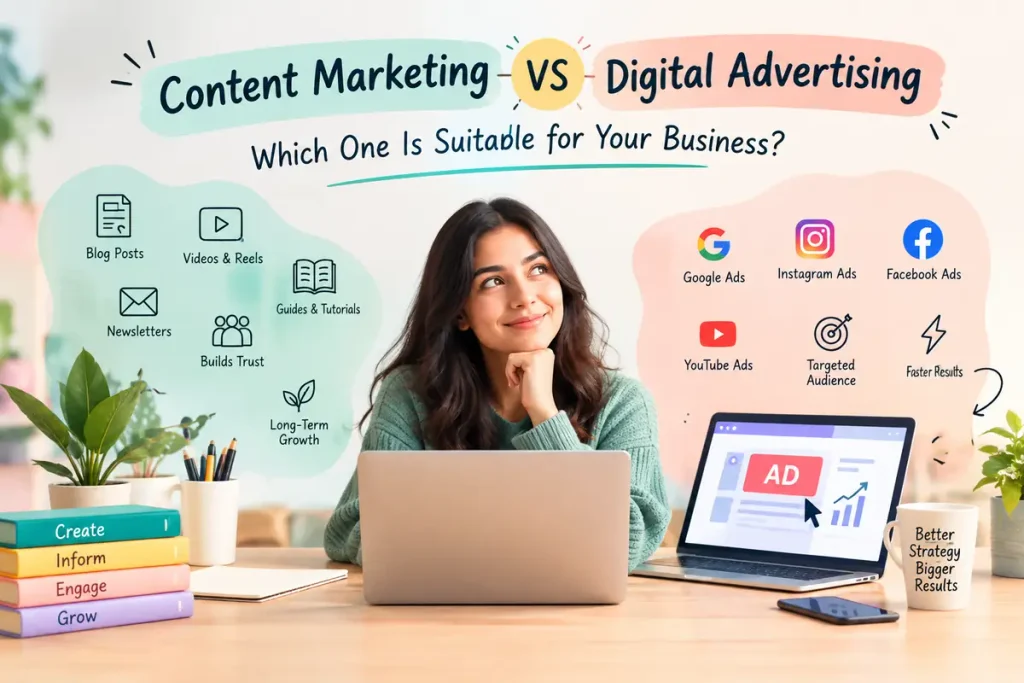
What Is Content Marketing?
Content marketing is all about creating useful content that people actually want to consume.
Instead of constantly telling people to buy something, you give them information, ideas, answers, or entertainment that they find valuable.
This content can take many forms, including:
- Blog posts
- Instagram posts
- Reels and videos
- Guides and tutorials
- Infographics
- Case studies
- Email newsletters
- Podcasts
- Ebooks
For example, imagine a skincare brand.
Instead of posting only product advertisements, the brand could create content about choosing skincare products, understanding ingredients, building a simple routine, or avoiding common skincare mistakes.
Someone searching for this information may discover the brand through its content. Even if that person does not make a purchase immediately, they have now become familiar with the business.
That is the real strength of content marketing.
It focuses on building a relationship before asking for a sale.
What Is Digital Advertising?
Digital advertising is a little more direct.
Here, businesses pay online platforms to show their advertisements to specific audiences.
You have probably seen digital ads while scrolling through Instagram, watching YouTube, searching on Google, or browsing websites.
Some common examples include:
- Google Search Ads
- Instagram Ads
- Facebook Ads
- YouTube Ads
- Display Ads
- Shopping Ads
- Retargeting Ads
For example, suppose a local clothing store has a new collection.
Instead of waiting for people to discover the collection naturally, the store can run an Instagram advertisement showing the new products to people who are likely to be interested.
The biggest advantage is speed.
You can create a campaign, set a budget, select an audience, and start reaching potential customers much faster than you usually can with organic content.
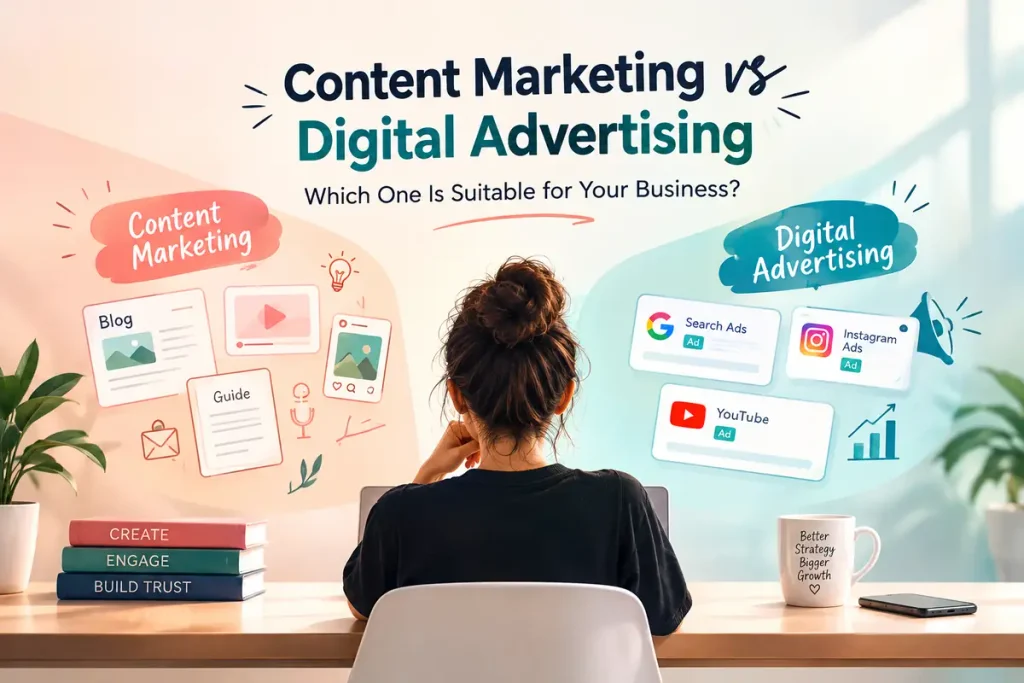
Content Marketing vs Digital Advertising – Difference
At first glance, both strategies may seem similar because they have the same broad goal: getting people interested in a business.
But the way they achieve that goal is different.
| Content-based marketing | Digital Advertising |
| Focuses on providing value | Focuses on paid promotion |
| Builds relationships over time | Can reach people quickly |
| Mainly uses organic distribution | Uses paid distribution |
| Can continue bringing traffic after publishing | Usually depends on an active campaign |
| Strong for education and trust | Strong for immediate reach and conversions |
| Usually produces gradual results | Can produce faster results |
Here’s a simple way to tell them apart:
Content marketing earns attention. Digital advertising pays to get attention.
Of course, that does not mean one is automatically better than the other.
Why Content Marketing Takes Time but Can Pay Off
- One of the biggest advantages of content marketing is that good content does not necessarily disappear after a few days.
- Think about a blog post you published six months ago.
- If it is useful and properly optimized for search engines, people may still discover it through Google months or even years later.
- The same can happen with videos, guides, tutorials, and other evergreen content.
- This makes content marketing particularly useful for businesses that want to build a strong online presence over time.
- For example, a digital marketing consultant in Thrissur could publish helpful articles about SEO, Google Ads, social media marketing, and content creation.
- A person searching for answers to those topics could find one of the agency’s articles.
- If the article genuinely helps them, the business has already created a positive impression before the person ever becomes a customer.
- That is something a simple advertisement cannot always achieve.
Why Digital Advertising Works Faster
Content marketing is like planting a seed: it needs time to grow.
Digital advertising is more like turning on a spotlight.
Once your campaign is active, your advertisement can start appearing in front of your chosen audience.
This makes digital advertising especially useful when a business has a time-sensitive goal.
For example, you might want to:
- Promote a limited-time offer
- Launch a new product
- Generate enquiries
- Increase website visits
- Get more Instagram messages
- Promote an event
- Reach customers in a specific location
Let’s say a restaurant is introducing a weekend special. Waiting several months for organic traffic would not make much sense. A targeted social media campaign could get the offer in front of local customers much faster. That is where paid advertising becomes extremely useful.
Which One Costs More?
This is where things get a little tricky.
It is tempting to say that content marketing is free because you do not have to pay for every person who sees your blog post or social media content.
But creating quality content still takes resources.
Someone has to research the topic, write the content, design graphics, shoot videos, edit them, optimize them, and publish them.
Digital advertising has a more obvious cost because you are paying the advertising platform for distribution.
However, you have much more control over your spending. You can decide how much you want to spend per day or for an entire campaign.
So instead of asking:
“Which one is cheaper?”
A better question is:
“Which one gives my business the best return for my current goal?”
The answer can be different for every business.
When Should You Use Content Marketing?
Content marketing is a good choice when your main goal is to build something that lasts.
It can be especially useful if you want to :-
Build Brand Awareness
- Regularly sharing useful content can help people become familiar with your brand.
Improve SEO
- Well-optimized content can help your website appear when people search for topics related to your business.
Build Trust
- When you consistently answer questions and provide useful information, people are more likely to see your brand as knowledgeable and reliable.
Educate Customers
- Some products or services require customers to understand their benefits before making a decision. Content is a great way to explain them.
Build A Long-Term Audience
- Content gives people a reason to keep coming back to your website or social media platforms.
When Should You Use Digital Advertising?
Digital advertising is particularly useful when you need to reach people quickly.
It can work well when you want to:
Generate Leads
- Businesses can use advertisements to direct people toward enquiry forms, landing pages, websites, or messaging platforms.
Increase Sales
- Product-focused advertisements can take potential customers directly to a product or checkout page.
Promote An Offer
- If an offer is available for only a few days, paid advertising can help get it in front of more people quickly.
Reach A Specific Audience
- Advertising platforms allow businesses to target audiences based on factors such as location, interests, demographics, and online behaviour.
Retarget Potential Customers
- Someone may visit your website without buying anything. Retargeting can help remind them about your brand later.
Content Marketing vs Digital Advertising: Which Is Better for SEO?
- If your main goal is improving organic search visibility, content marketing has the clear advantage.
- Search engines need useful information to understand what a website is about.
- Creating high-quality blog posts, service pages, guides, FAQs, and other useful resources gives your website more opportunities to appear for relevant searches.
- Digital advertising can bring traffic to your website, but paid advertisements do not directly replace the need for useful organic content.
- This is why many businesses combine SEO and content marketing instead of relying entirely on paid traffic.
Can You Use Both Strategies Together?
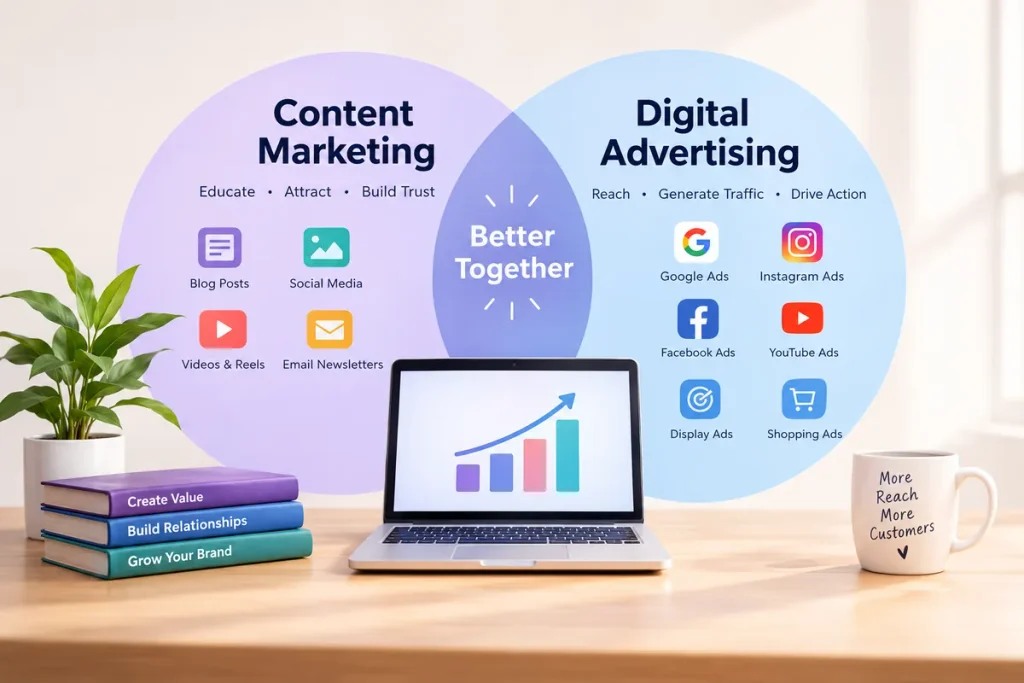
Absolutely—and this is where things get interesting. You do not necessarily have to choose between the two. In fact, combining both approaches can help you build a stronger marketing strategy
Imagine you have written a detailed blog post that answers a common question your customers ask.

You could:
- Publish the blog post on your website.
- Optimize the content for search engines.
- Share the blog post across your social media platforms.
- Create a short Reel based on the same topic.
- Promote the content through paid advertising.
- Retarget users who have previously interacted with your content.
- Guide interested visitors towards your products or services.
Now, your content does more than simply sit on your website. It helps attract visitors, reach a wider audience, and create opportunities to connect with potential customers.
You are using advertising to amplify content that already provides value.
This approach can help businesses get both short-term visibility and long-term organic growth.
How to Choose the Right Strategy
Still wondering where you should start?
Ask yourself these five questions.
1. What Is My Goal?
- Do you want sales, leads, website traffic, brand awareness, or long-term visibility?
- Your goal should come first.
2. How Quickly Do I Need Results?
- If you need immediate visibility, digital advertising may be the better starting point.
- If you are building a long-term presence, content marketing deserves your attention.
3. What Is My Budget?
- Consider both your financial budget and your available time.
- Content may require more time and effort, while advertising requires a direct media budget.
4. Where Does My Audience Spend Time?
- Think about how your customers discover information.
- Do they search on Google? Watch YouTube videos? Scroll through Instagram? Read blogs?
- Meet your audience where they already are.
5. How Will I Measure Success?
Do not rely only on likes or views.
For content marketing, you can track:
- Organic traffic
- Search rankings
- Engagement
- Page views
- Returning visitors
- Leads
For digital advertising, useful metrics include:
- Click-through rate
- Cost per click
- Impressions
- Leads
- Conversions
- Cost per conversion
- Return on ad spend
These numbers can tell you what is actually working.
The Smart Approach: Use Both
The Content Marketing vs Digital Advertising debate does not always have to end with one winner.
For many businesses, the smartest approach is to use both strategies for different purposes.
Use content marketing to educate, attract, and build trust.
Use digital advertising to increase reach, generate traffic, and drive faster action.
Think of it this way:
Content marketing builds the relationship. Digital advertising starts the conversation faster.
When the two work together, businesses can create a customer journey that feels much more natural.
Someone may first discover your brand through an advertisement. Later, they might read one of your blog posts, watch a video, follow your Instagram page, and eventually become a customer.
That journey can take time—but every interaction helps build familiarity.
Final Thoughts
- When comparing Content Marketing vs Digital Advertising, there is no single strategy that works perfectly for every business.
- Content marketing is a long-term game. It can help businesses build authority, improve organic visibility, educate customers, and develop stronger relationships with their audience.
- Digital advertising is more immediate. It can help businesses reach targeted audiences, promote offers, generate leads, and drive conversions faster.
- The best choice depends on your goals, audience, budget, and timeline.
- And if your resources allow it, you do not have to choose just one.
- Create content that people find useful. Use advertising to help the right people discover it. Then give them a reason to stay.
- That is where digital marketing becomes more than just getting clicks—it becomes a way to build a brand people remember.
Frequently Asked Questions
Is content marketing better than digital advertising?
Both strategies offer different benefits, and the better choice depends on your business goals. Content marketing is useful for building long-term visibility, improving SEO, educating customers, and earning trust. Digital advertising helps businesses reach targeted audiences faster and generate leads or sales. The right choice depends on your marketing goals and available resources.
Is content marketing free?
Content marketing is not completely free. Although businesses do not usually pay for every organic visitor, creating quality content requires time, research, planning, writing, design, and sometimes paid tools or professional services.
Is digital advertising worth it for small businesses?
Yes, digital advertising can be valuable for small businesses when campaigns are planned carefully. Businesses can start with a manageable budget, target relevant audiences, and monitor campaign performance to understand whether their spending is producing useful results.
Can content marketing improve SEO?
Yes. Publishing useful, relevant, and well-optimized content can help search engines understand your website and its topics. Blog posts, guides, and informative resources can also create more opportunities to attract organic traffic from relevant searches.
Should a new business start with content marketing or digital advertising?
The best starting point depends on the business’s goals, budget, and timeline. Content marketing can help build long-term visibility and customer trust, while digital advertising can provide faster exposure. A new business can also combine both approaches based on its available resources.
How long does content marketing take to work?
Content marketing does not have a fixed timeline for delivering results. Its progress depends on content quality, competition, SEO efforts, publishing consistency, website authority, and audience interest. It generally takes time to build organic visibility and attract a steady audience.