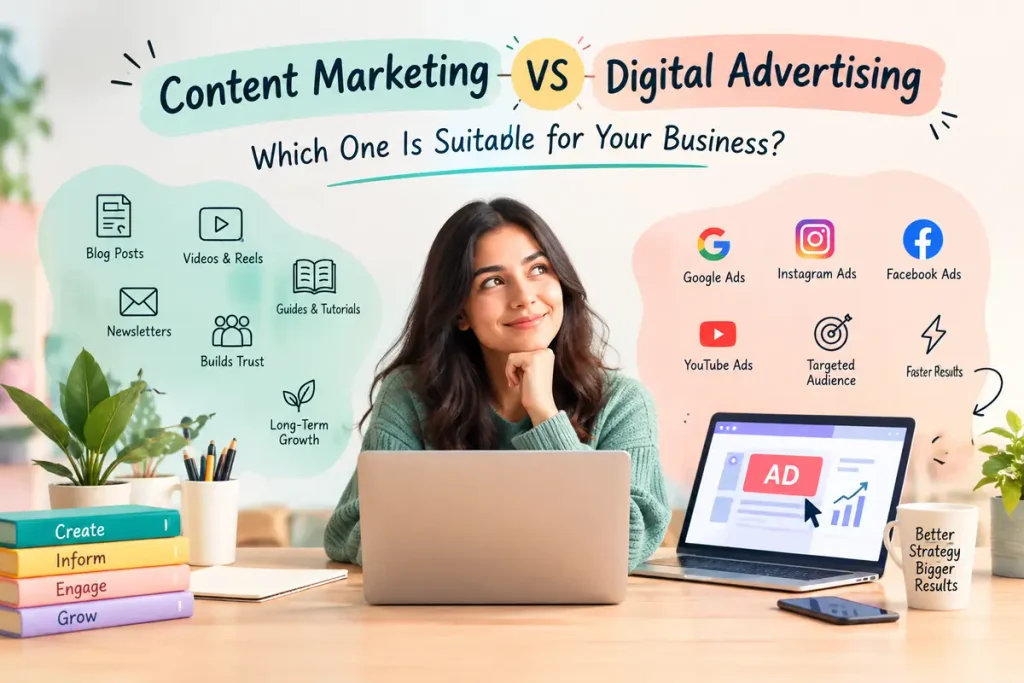
Content Marketing VS Digital Advertising: Which One Is Suitable For Your Business?
Imagine you have a great product, a good-looking website, and an Instagram page that you update regularly. But there is still one problem people are not finding your business. This is something everybody struggle with today. Having a product or service is not enough. You also need a way to reach the right people and give them a reason to pay attention. That is where digital marketing comes in. Two strategies that businesses often consider are content marketing and digital advertising. Both can help a business reach potential customers, but they work in very different ways.So, when it comes to Content Marketing vs Digital Advertising, which one should you choose?It really comes down to your goals, how quickly you want results, and how much time and budget you have. Let’s make it easier to understand. What Is Content Marketing? Content marketing is all about creating useful content that people actually want to consume. Instead of constantly telling people to buy something, you give them information, ideas, answers, or entertainment that they find valuable. This content can take many forms, including: For example, imagine a skincare brand. Instead of posting only product advertisements, the brand could create content about choosing skincare products, understanding ingredients, building a simple routine, or avoiding common skincare mistakes. Someone searching for this information may discover the brand through its content. Even if that person does not make a purchase immediately, they have now become familiar with the business. That is the real strength of content marketing. It focuses on building a relationship before asking for a sale. What Is Digital Advertising? Digital advertising is a little more direct. Here, businesses pay online platforms to show their advertisements to specific audiences. You have probably seen digital ads while scrolling through Instagram, watching YouTube, searching on Google, or browsing websites. Some common examples include: For example, suppose a local clothing store has a new collection. Instead of waiting for people to discover the collection naturally, the store can run an Instagram advertisement showing the new products to people who are likely to be interested. The biggest advantage is speed. You can create a campaign, set a budget, select an audience, and start reaching potential customers much faster than you usually can with organic content. Content Marketing vs Digital Advertising – Difference At first glance, both strategies may seem similar because they have the same broad goal: getting people interested in a business. But the way they achieve that goal is different. Content-based marketing Digital Advertising Focuses on providing value Focuses on paid promotion Builds relationships over time Can reach people quickly Mainly uses organic distribution Uses paid distribution Can continue bringing traffic after publishing Usually depends on an active campaign Strong for education and trust Strong for immediate reach and conversions Usually produces gradual results Can produce faster results Here’s a simple way to tell them apart: Content marketing earns attention. Digital advertising pays to get attention. Of course, that does not mean one is automatically better than the other. Why Content Marketing Takes Time but Can Pay Off Why Digital Advertising Works Faster Content marketing is more like planting a seed. It need time to grow. Digital advertising is more like turning on a spotlight. Once your campaign is active, your advertisement can start appearing in front of your chosen audience. This makes digital advertising especially useful when a business has a time-sensitive goal. For example, you might want to: Let’s say a restaurant is introducing a weekend special. Waiting several months for organic traffic would not make much sense. A targeted social media campaign could get the offer in front of local customers much faster. That is where paid advertising becomes extremely useful. Which One Costs More? This is where things get a little tricky. It is tempting to say that content marketing is free because you do not have to pay for every person who sees your blog post or social media content. But creating quality content still takes resources. Someone has to research the topic, write the content, design graphics, shoot videos, edit them, optimize them, and publish them. Digital advertising has a more obvious cost because you are paying the advertising platform for distribution. However, you have much more control over your spending. You can decide how much you want to spend per day or for an entire campaign. So instead of asking: “Which one is cheaper?” A better question is: “Which one gives my business the best return for my current goal?” The answer can be different for every business. When Should You Use Content Marketing? Content marketing is a good choice when your main goal is to build something that lasts. It can be especially useful if you want to :- Build Brand Awareness Improve SEO Build Trust Educate Customers Build A Long-Term Audience When Should You Use Digital Advertising? Digital advertising is particularly useful when you need to reach people quickly. It can work well when you want to :- Generate Leads Increase Sales Promote An Offer Reach A Specific Audience Retarget Potential Customers Content Marketing vs Digital Advertising: Which Is Better for SEO? Can You Use Both Strategies Together? Absolutely—and this is where things get interesting.You do not necessarily have to choose between the two.In fact, combining them can create a stronger marketing strategy .Imagine you have written a detailed blog post that answers a common question your customers ask. You could: Now your content is doing more than just sitting on your website. You are using advertising to amplify content that already provides value. This approach can help businesses get both short-term visibility and long-term organic growth. How to Choose the Right Strategy Still wondering where you should start? Ask yourself these five questions. 1. What Is My Goal? 2. How Quickly Do I Need Results? 3. What Is My Budget? 4. Where Does My Audience Spend Time? 5. How Will I Measure Success? Do not rely only on likes or views. For content marketing, you can